
Ecological assessment of development sites
We have had a busy winter and spring carrying out ecological assessments. Ecology surveys have been regarded as essential since the commencement of lockdown, with DEFRA agreeing with the CIEEM that ecologists should continue with outdoor work where the Public Health guidelines can be followed. DEFRA recognises that the cessation of environmental survey work would risk later delays in the development sector.
In normal times, much of our work is carried out at isolated sites, and it has been relatively easy to continue with much of our typical work. We have therefore been able to carry out not only ecological assessments but detailed newt surveys too. The ability to carry out bat surveys has to be considered more carefully but we have been able to carry out some assessments of empty buildings. Night-time surveys (due to commence soon) are likely to be possible at some sites. We also remain on hand to provide advice.
Since we are able to continue carrying out detailed species surveys, we will be able to move on this year to apply for mitigation licences. A licence may be required before development can proceed at a site where there would be an impact on a European Protected Species (e.g. Bats, Great Crested Newt, Dormouse or Otter). In other instances, a Work Method Statement or Reasonable Avoidance Measures have been sufficient.
Enhancements at development sites
As well as essential mitigation, enhancements are also required at all development sites. We aim to provide clients with suggestions for enhancements so that these can be included in our ecological assessment and added to landscape plans, before submission to planning. We can also draw up simple Biodiversity Management Plans or Habitat Enhancement Schemes, which may be requested by the planning authority as a condition, after planning permission has been granted.
Vegetation and plant surveys
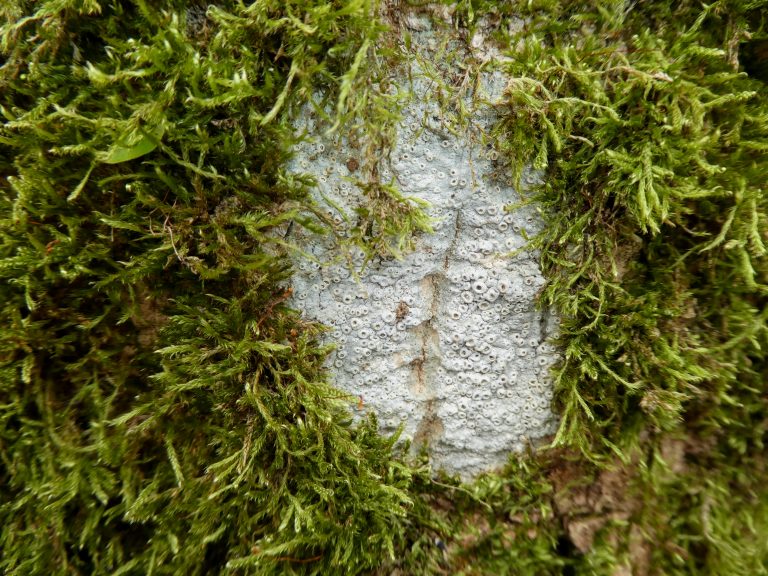
We have recently been involved in lichen surveys in a couple of ancient woodlands in east Shropshire, following a formal method that looks for selected nitrogen sensitive and nitrogen tolerant species. Nitrogen-tolerant species seemed to dominate on the higher exposed ground. Additional walkovers in the lower parts of river and stream valleys produced some interesting results with more nitrogen-sensitive species including some ancient woodland indicators – see picture above of Bark Barnacles (Thelotrema lepardinum).
Kate, as county recorder for Montgomeryshire, has completed the input of thousands of field records since 2000. She has also verified numerous records from other sources. The recording period for the next national distribution atlas ended on March 31st.
Veteran trees
We are still involved with coordinating surveys for invertebrates and other species groups in a registered park in South Shropshire, where there are several veteran trees. This project started in October 2019 and is likely to be an exciting project resulting in records of great interest.
Spring
With the world in disarray, it is reassuring that nature carries on as usual. The bluebells are out, the amphibians are returning to pools to breed, birds are nesting and animals are coming out of hibernation.